
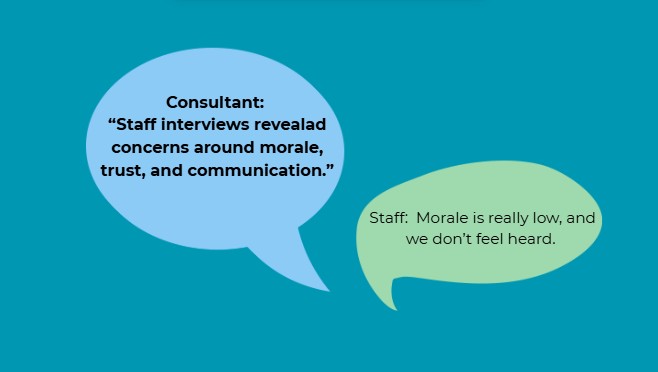
Have you ever been in a situation where leaders didn’t trust the feedback from their own staff members?
A Consulting Dilemma
I was asked to interview team members for a department that was experiencing low morale. In discussing this request with the department leaders, I learned that they already had the team’s feedback – so I didn’t understand why they needed additional interviews.
For me, that brought the underlying issue into focus: Why couldn’t they rely on what they heard directly from their team?
But I was asked to conduct the interviews, which I did. I’m actually glad that I did, because in addition to hearing the substance of their concerns, I witnessed the emotional toll of their not feeling heard – and it points to the feedback loop that was missing in the system.
In my report, we framed the findings in terms of what was missing: creating psychological safety, holding senior leaders accountable and fixing inter-departmental communication issues.
The leaders weren’t surprised by the findings, but the way we framed the issues had an impact on them.
My takeaway: Organizations often don’t trust the data they already have—especially when it comes from their own people. They look to external validation.
The question for me is: Why? What assumptions do leaders make about trusting staff feedback?
- Bias: Leaders may think that externals are neutral and unbiased, so it’s easier to take their critique, because “they don’t have skin in the game.”
- Hierarchy: Consultants are usually seen as “equal” to leaders, whereas staff are subordinate to them. In this case credibility is shaped by hierarchy.
- Authority: Leaders may experience staff feedback as a challenge to their authority.
- Accountability: Receiving feedback in a team setting is easier to absorb because the accountability is diffused and shared with others. It’s harder to absorb when feedback may be focused on the team or departmental leadership.
- Unconscious dynamics: Being open to criticism requires people to be somewhat vulnerable, which can be difficult.
What is the consultant’s role?
I believe it’s our role to help leaders notice their assumptions about trusting staff feedback, and to question those.
- What would have to shift in their mindset to accept staff feedback directly?
- How could they think about feedback as a mechanism for learning and strengthening relationships, rather than a challenge to their authority?
- How could they use the feedback in a way that increases psychological safety? That is, leaders often expect openness from others while not fully recognizing what openness asks of them personally.
Interrupting the Pattern
Earlier in my career, I was invited to consult to an organization about how to improve the functioning of the IT team. When I interviewed team members, I heard that they had shared their recommendations to their supervisor, and I realized that I wasn’t comfortable taking a contract where I would be speaking on their behalf – so I gave up the assignment. I didn’t want to be complicit in their ignoring the team’s input. Plus, I was hoping that my action might influence the leader to listen to them.
What role do we want to play in reinforcing or interrupting organizational patterns?
If something here moved you or helped you understand yourself or the system you’re part of a little more clearly, I’d love to hear about it.
Discover more from TRANSFORMATIVE COACHING
Subscribe to get the latest posts sent to your email.

